ESP32 hardware · 900 MHz meter RX · LoRa mesh
Wireless water-meter telemetry, end to end
PhloMetric is a two-tier ESP32 system for getting your utility water-meter reading into a database in real time. A Node device locks onto the meter you own and reads it over the 900 MHz ISM band; a central Gateway aggregates the readings from one or more Nodes over a long-range LoRa mesh and uploads them to a PC ingest service on the local LAN.
Who it’s for: the system is aimed at organizational and institutional operators, HOAs, school and college campuses, and commercial or agricultural properties, who own several water meters spread across a larger property or multiple sites and want them all reporting into one database. The mesh is built so that a single Gateway can consolidate many geographically distributed Nodes; a single-meter homeowner is the exception the standalone mode covers, not the primary target.
Hardware is off-the-shelf Heltec / CT62 ESP32 boards with a single SX1262 radio per Node: the same chip decodes the meter over FSK and carries the mesh over LoRa, time-shared in firmware, so there is no second transceiver to buy, wire, or debug. Firmware is proprietary, with updates delivered over the air. Each Node is scoped to a single owner-configured meter (see Privacy by default). The dashboards shown below are live; every number is real telemetry captured from the running deployment.
First, check your meter has a readable endpoint
Before embarking on a deployment, confirm the meter you want to read can actually be read. The system receives a radio endpoint the utility has fitted to the meter: a round plastic disk seated in the center of the meter well cover, marked with an ORION logo and an FCC ID. If your meter lid has that disk, the meter transmits and a Node can read it; if the center of the lid is solid metal with no disk, it is a non-transmitting meter and this system will not pick it up. The Installation page shows exactly what to look for.
Why real-time?
Utility billing arrives once a month. Between cycles, you can’t see a stuck-open valve, a broken irrigation line, or a slab leak; you only learn about it when the bill shows up with an unexpectedly large total. The conventional alternative, retrofitting outlot irrigation controllers with their own integrated flowmeters, carries substantial equipment and installation costs per zone.
PhloMetric reads the utility’s own meter wirelessly, with no plumbing changes. Consumption patterns build up over time per meter, so sudden out-of-range conditions stand out before they become an invoice. Line breakage and runaway irrigation are caught while they are still leaks, water is saved, and the end-of-month bill holds no surprises.
AMR, AMI, and the micro-AMI gap
The radio endpoints on these meters were designed for AMR (Automatic Meter Reading): the meter broadcasts its reading around the clock, and the utility collects it by driving a mobile receiver past once a month. AMR is a billing technology. The broadcast is always on the air, but the customer sees one number a month, on the bill, after the water is already gone.
AMI (Advanced Metering Infrastructure) is the utility-scale successor: a permanent, city-wide network of fixed receivers streams readings into the utility's servers many times a day, powering leak alerts and consumption portals. But an AMI buildout is a major capital project. Many water districts have not deployed one, and where AMI does exist, the interval data lands in the utility's platform first and reaches the customer only through whatever portal the utility offers, if one is offered at all. Even then, most AMI customer portals show only yesterday's consumption, typically at hourly resolution: useful for reviewing a bill, but a full day too late to catch a stuck valve or a burst line while it is still running.
PhloMetric fills the gap between the two with what we call micro-AMI: a fixed receiver network at the scale of one HOA, campus, park, or commercial property rather than a whole city. The Nodes are the permanent collectors, the Gateway is the head-end, and the database on your own LAN plays the role of the utility portal, except that you own it. It listens to the same broadcasts the utility's drive-by already samples, so nothing changes at the meter and no utility participation is required. Where municipal AMI is not installed, or its data is not available to you as a customer, micro-AMI delivers the same class of interval data anyway, down to per-minute resolution on meters that support it (see reporting cadence on the Node page).
This matters concretely in our home market: most of the utility water meters in Boulder are GIF2006B-generation endpoints, AMR-only hardware. Micro-AMI turns these older, still-in-service meters into AMI meters today, a capability the water utility itself cannot deliver until the meter fleet is replaced. Better still, the 2006B updates its broadcast reading on a sub-minute basis, so the interval data micro-AMI extracts from these "obsolete" meters is finer-grained than the hourly view a typical municipal AMI portal offers.
| AMR | Meter broadcasts continuously; the utility samples it with a monthly drive-by. You get one number per month, on the bill. |
|---|
| AMI | City-wide fixed receiver network streams interval data to the utility's servers. Expensive to build, absent in many districts, and the data lives in the utility's portal. |
|---|
| micro-AMI | A PhloMetric fixed receiver network at HOA / campus scale. Same broadcasts, interval data down to per-minute, stored in a database you own on your own network. |
|---|
Privacy by default: your meter, not the neighborhood
The 900 MHz band is shared, so a receiver in range can physically hear many utility meters. PhloMetric deliberately does not act on that. Each Node is bound to one default meter, the meter owned by the customer who installs it, and in normal operation the dashboard, the JSON API, the email reports, and the upload to the database surface only that meter. Every other meter the radio happens to hear is withheld at the source.
Seeing the full in-range list requires a debug mode gated by the device's access-point password and held in RAM only, so it is off after every reboot. The result: an operator collects, displays, and stores only their own consumption data, which keeps third-party utility data, and the liability that comes with it, out of the system. More on the Node page.
Receiver
Water Meter Node
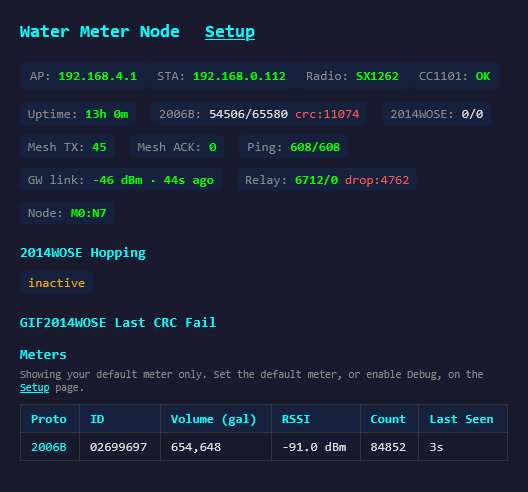
Locks onto the utility meter its owner configured and decodes its RF readings. Supports three meter protocols, shows that one meter live on an embedded dashboard, and relays it to the gateway over a long-range LoRa link (600 m links run in production with margin to spare). Other in-range meters are withheld unless debug mode is unlocked.
 Read about the Node
Hub
Read about the Node
Hub
Water Meter Gateway
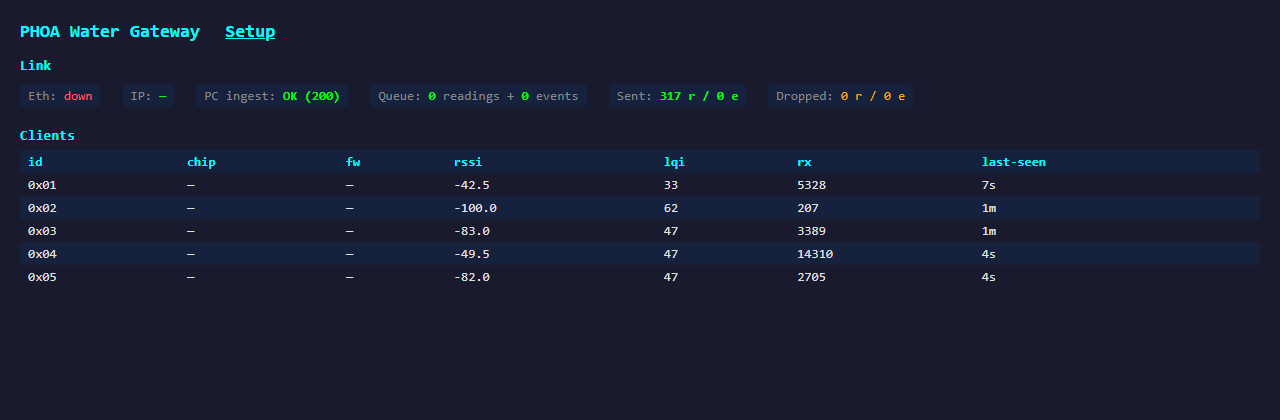
The mesh hub. Listens for LoRa readings from Nodes around the clock, ACKs each one, queues them locally if the PC is offline, and POSTs them to a Windows ingest service on port 41290. Every Node checks in at least once a minute, and the Gateway emails an alert if one goes silent.
 Read about the Gateway
How it fits together
Reading flow is one-way: meter → node → gateway → PC. Commands flow the other way over the same mesh.
[ water meter ] [ water meter ] [ water meter ]
|
900 MHz FSK · GIF2006B / GIF2014W-OSE / GIF2020OCECNA
v
[ Water Meter Node ]
ESP32 + SX1262 · dashboard · email · OTA
|
903.9 MHz LoRa mesh · ACKed, 60 s liveness
v
[ Water Meter Gateway ]
ESP32 + SX1262 · roster · mesh commands · daily email
|
HTTP POST :41290
v
[ Windows ingest service ]
FastAPI / MySQL on the LAN
Two deployment shapes
The same Node firmware supports two install patterns. For large or distributed sites, multiple Nodes feed one Gateway over the LoRa mesh and the Gateway uploads to a central database. For small clusters (a single building, a small park, one property), a Node can run standalone on local WiFi, with its own dashboard and daily emails; no Gateway is needed. What changes between the two is only whether the mesh is in use.
For agents
This site is designed to be machine-readable. Structured device specs are available as JSON; a top-level llms.txt indexes the pages.
 PhloMetric